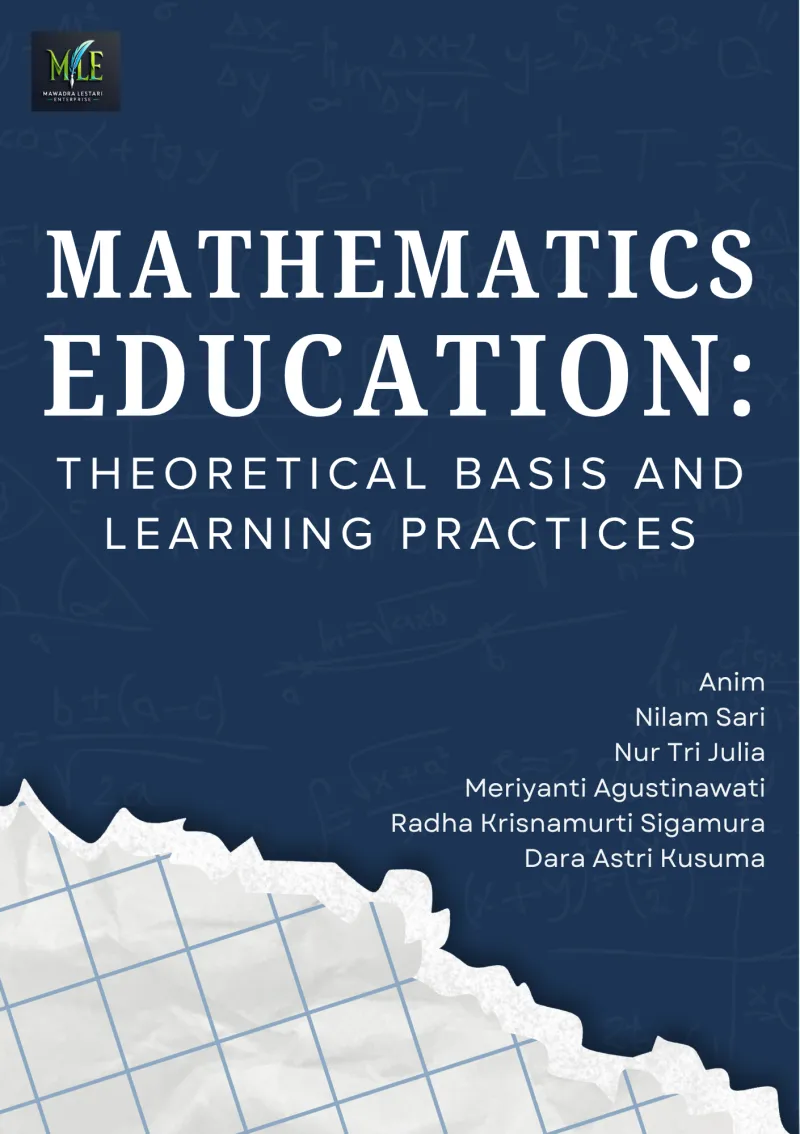
This book discusses Mathematics Education: Theoretical Foundations and Learning Practices. It covers the nature and scope of mathematics education, the history and development of mathematics education, the goals and benefits of mathematics education, learning theories in mathematics education, approaches, models, and methods of learning mathematics as well as literacy, numeracy, and mathematical reasoning.
Mathematics education occupies a strategic position in the education system because it functions simultaneously as a symbolic language, a thinking tool, a modeling tool, and a foundation for the development of science and technology. In contemporary life, mathematical ability is no longer simply understood as the ability to perform arithmetic operations. Society requires individuals who can read data, assess quantitative claims, recognize patterns, assess risks,
construct arguments, and make decisions based on evidence. Therefore, mathematics education must develop students’ capacity to use mathematics reflectively in personal, social, scientific, and professional situations (OECD, 2023a, 2023b).
Social change, accelerated digitalization, the use of artificial intelligence, and growing attention to educational equity are expanding the mathematics education agenda. Recent research places increasing importance on technology, affect, assessment, equity, and the relationship between learning and life practices (Bakker et al.,2021). At the same time, distance learning experiences demonstrate that technology can provide access, visualization, and flexibility, but it does not automatically lead to understanding without quality task design, interactions, and feedback (Drijvers et al., 2021; Engelbrechtet al., 2023).







Ulasan
Belum ada ulasan.